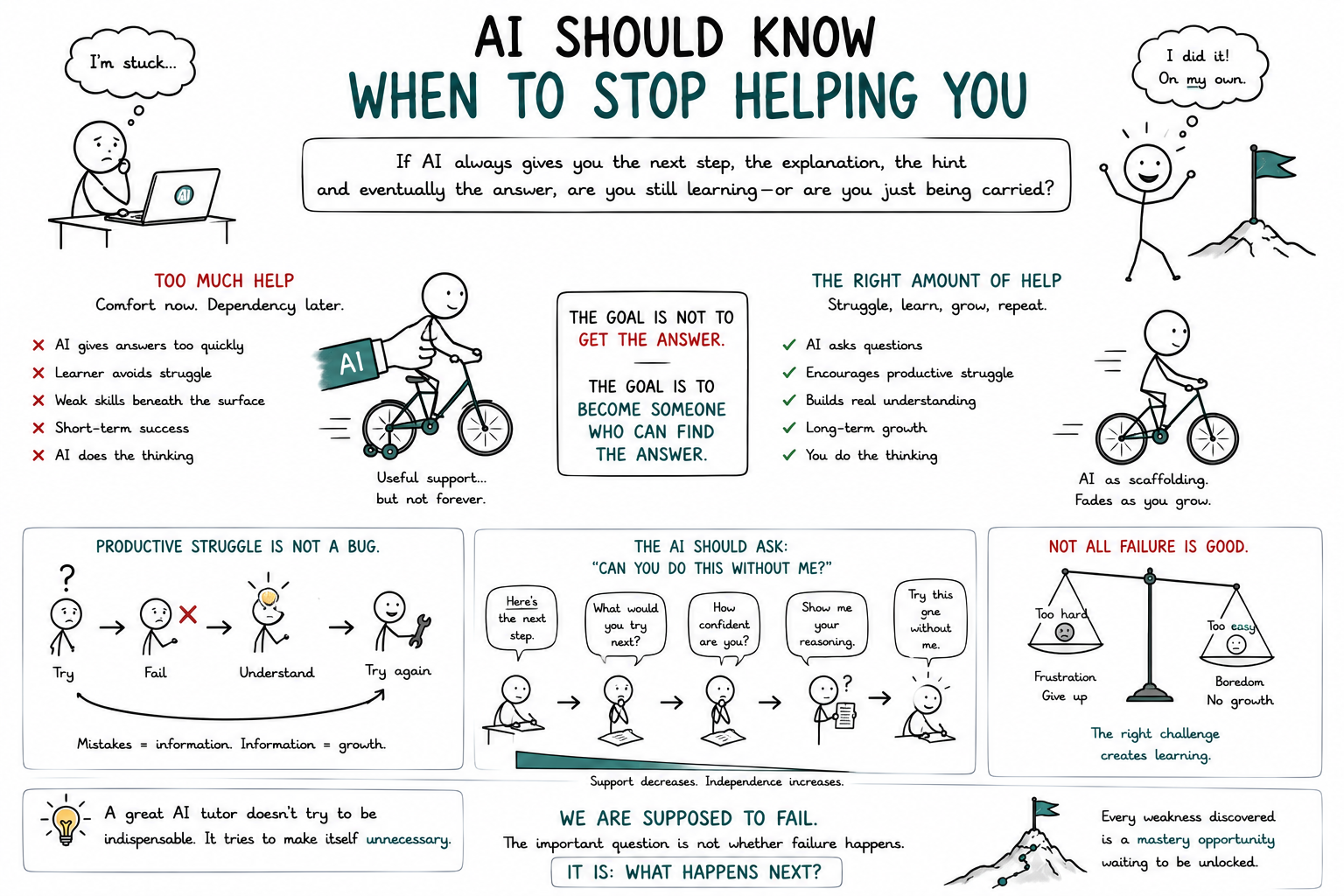
If AI always gives you the next step, the explanation, the hint and eventually the answer, are you still learning—or are you just being carried?
AI can make learning dramatically easier.
That sounds like an obvious win.
A student gets stuck.
AI explains the problem.
Still confused?
AI explains it differently.
Need a hint?
AI gives one.
Need another?
AI gives another.
And if things get difficult enough, AI can simply show the answer.
Perfect.
Except there is a problem.
Learning is not supposed to be frictionless.
Sometimes the moment when a learner feels stuck is not a failure of the learning system.
It is the learning.
And if AI removes that moment too quickly, it may also remove the thing we were trying to create.
Understanding.
What If the Best AI Tutor Sometimes Refuses to Help?
That sounds strange.
We normally evaluate AI tutors by asking questions like:
How accurate are the explanations?
How personalized are they?
How quickly can they solve the student's problem?
How well can they adapt to the learner?
But perhaps we should add another question:
Does the AI know when to shut up?
Because a great teacher does.
A teacher does not necessarily answer every question immediately.
Sometimes they say:
What do you think?
Sometimes:
Try again.
Sometimes:
Show me where you got stuck.
Sometimes they simply wait.
That silence can be uncomfortable.
But it forces the learner to do something incredibly important.
Think.
Helping Too Much Can Become a Form of Interference
Imagine learning to ride a bicycle.
Someone holds the bicycle behind you.
At first, that is useful.
Without support, you might immediately fall.
But what happens if they never let go?
You could ride for kilometers.
You might feel successful.
You might even believe you are getting better.
But the moment their hand disappears, you fall.
The support was useful.
Then it became dependency.
AI can create exactly the same problem.
A learner writes the first sentence.
AI improves it.
The learner gets stuck on an equation.
AI suggests the next operation.
The learner cannot remember something.
AI retrieves it.
The learner struggles to connect two ideas.
AI connects them.
Every individual intervention looks helpful.
But eventually we have to ask:
Who is actually doing the cognitive work?
The Goal Is Not to Complete the Task
This distinction becomes increasingly important as AI becomes more capable.
AI is extremely good at helping people finish things.
Finish the essay.
Finish the equation.
Finish the homework.
Finish the code.
Finish the assignment.
But education should not optimize primarily for completed tasks.
It should optimize for changed learners.
Those are not the same thing.
A perfectly completed assignment can hide almost zero learning.
A messy, incomplete attempt can contain enormous learning.
So perhaps the success metric for educational AI should not be:
Did the student reach the correct answer?
Maybe it should be:
Could the student reach the next answer with less help?
That is a completely different design philosophy.
Productive Struggle Is Not a Bug
Modern software is obsessed with removing friction.
One click instead of three.
Autocomplete instead of typing.
Recommendations instead of searching.
Automation instead of manual work.
Usually, that is good product design.
But education is unusual.
Some friction is the product.
Retrieving something from memory is harder than rereading it.
Trying to solve a problem is harder than watching someone solve it.
Explaining an idea yourself is harder than reading a perfect explanation.
Making a mistake is uncomfortable.
Being uncertain is uncomfortable.
Thinking is uncomfortable.
And yet those uncomfortable moments often create learning.
So when we bring conventional software thinking into education, we can accidentally make a dangerous assumption:
less friction = better learning experience.
Not necessarily.
Sometimes less friction simply means less learning.
The AI Should Ask: “Can You Do This Without Me?”
Imagine an AI learning system that actively tries to make itself unnecessary.
At first, it might provide significant support.
Then slightly less.
Then slightly less again.
Instead of immediately explaining a mistake, it might ask:
Can you find it yourself?
Instead of giving the next step:
What would you try next?
Instead of correcting an answer:
How confident are you?
Instead of solving the problem:
Show me your reasoning.
And eventually:
Try this one without me.
This would fundamentally change the relationship between the learner and the AI.
The AI would no longer behave like an infinite answer machine.
It would behave more like scaffolding.
Useful while needed.
Gradually removed as competence grows.
But When Should AI Stop Helping?
That is the difficult part.
Stop too early and the learner becomes frustrated.
Stop too late and the learner becomes dependent.
The right amount of help is probably constantly changing.
A beginner may need significant guidance.
Someone with partial understanding may need a hint.
Someone close to mastery may need nothing more than a question.
The AI therefore needs to understand more than the subject.
It needs some model of the learner.
What does this person already know?
What mistakes are they making?
Are they genuinely stuck?
Are they simply avoiding effort?
Have they attempted the problem?
How confident are they?
How much support did they need last time?
Can they retrieve the skill without assistance?
That is where educational AI becomes interesting.
Not:
How intelligently can AI answer questions?
But:
How intelligently can AI decide whether answering is actually helpful?
Failure Makes This Even More Complicated
There is another problem.
We should not romanticize struggle.
There is a difference between productive struggle and pointless frustration.
If a learner repeatedly fails without understanding why, motivation can collapse.
If every task feels impossible, they may stop trying altogether.
So the solution cannot simply be:
Make learning harder.
The challenge is much more subtle.
The learner needs enough difficulty to think.
Enough support to continue.
Enough success to believe progress is possible.
Enough failure to expose what they do not understand.
And enough independence to eventually prove that the knowledge is actually theirs.
That balance may become one of the most important design problems in AI-powered education.
APUOPE Should Not Try to Become Indispensable
This creates an interesting goal for APUOPE.
Most software companies want users to become increasingly dependent on their product.
More sessions.
More clicks.
More engagement.
More time spent inside the platform.
But a learning platform should be careful with that logic.
If a student needs the same level of help forever, something has gone wrong.
The system should ideally observe the learner becoming more capable.
Hints become smaller.
Explanations become shorter.
Questions become harder.
Support becomes less visible.
Eventually the learner faces a problem and solves it alone.
That moment might look terrible from a traditional engagement perspective.
The AI did almost nothing.
But educationally?
That may be the perfect outcome.
Maybe the Best AI Tutor Slowly Disappears
AI will soon be capable of explaining almost anything.
That is impressive.
But explanation may not be the hardest problem.
The harder problem may be restraint.
Knowing when to explain.
Knowing when to hint.
Knowing when to challenge.
Knowing when to let someone fail.
Knowing when to try again.
Knowing when silence is more useful than another thousand tokens of perfectly written assistance.
Because the purpose of an educational AI should not be to demonstrate how intelligent the AI is.
It should be to increase the intelligence, confidence and independence of the person using it.
And if we build these systems correctly, something strange should happen over time:
The learner should need them less.
So perhaps one of the most important questions in AI-powered education is not:
How much can AI help us?
It is:
When should it stop?